
 Back
BackWhat is the Canada Startup Visa Program?
The Canada Startup Visa (SUV) is a unique economic immigration pathway created to attract innovative entrepreneurs from around the world who have the vision and capability to build high-growth businesses in Canada. Unlike investor visas, which focus primarily on capital infusion, or entrepreneur visas, which often start with temporary residency, the SUV directly grants permanent residency (PR) to qualified founders. This allows entrepreneurs to focus entirely on scaling their venture while establishing long-term settlement in Canada with their families.
Launched to strengthen Canada’s innovation economy, the SUV targets businesses with potential for scalability, job creation, and positive economic impact. It reflects Canada’s broader vision: immigration not just as a demographic driver, but as a tool for economic competitiveness, technological advancement, and sustainable growth.
Canada’s Vision for Economic Immigration
Canada views immigration as a cornerstone of its economic policy. Rather than focusing solely on population numbers, programs like the SUV emphasize value creation:
- Developing cutting-edge products and services
- Strengthening Canada’s startup ecosystem
- Driving exports and global competitiveness
- Creating high-quality jobs for Canadian citizens and residents
By offering PR upfront, Canada ensures entrepreneurs commit to building within the country, anchoring management, staff, and operations domestically.
SUV vs. Investor and Entrepreneur Visas
The Startup Visa stands apart from other immigration pathways.
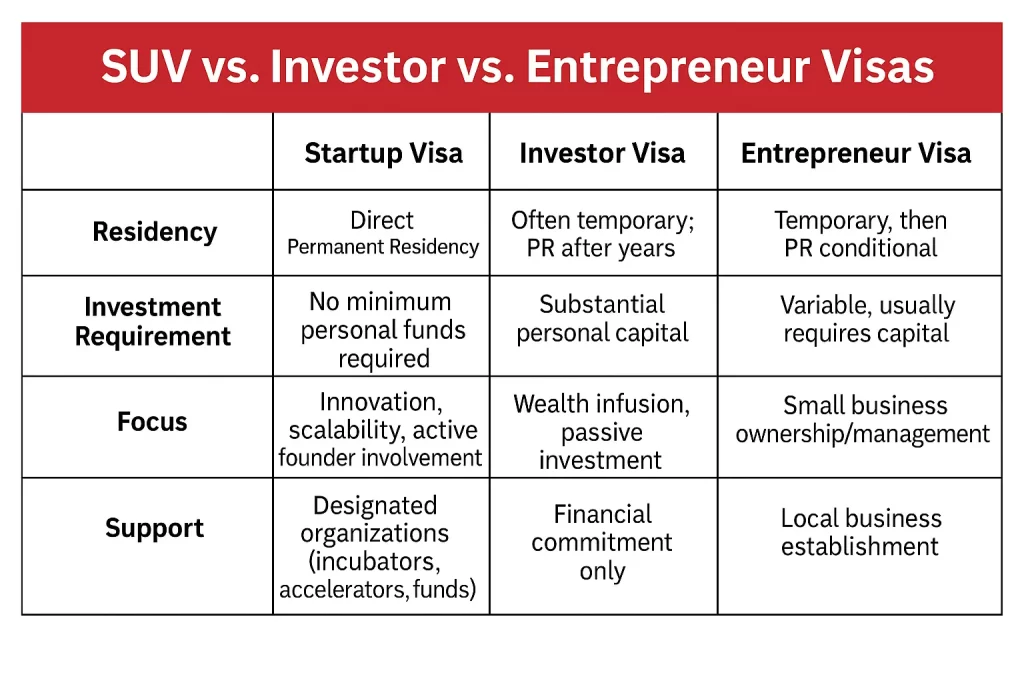
The SUV prioritizes innovation-driven businesses over wealth-driven applicants.
Key Features of the Canada Startup Visa Program
Direct PR Pathway for Founders and Families
Successful applicants receive PR from the outset. Spouses or common-law partners and dependent children are included, giving families stability through access to Canadian healthcare, education, and social services.
No Minimum Net Worth or Investment Requirement
The SUV lowers barriers for entrepreneurs who may not have deep personal wealth but do have transformative business ideas. Instead, designated organizations provide validation, mentorship, and resources.
Designated Organization Support
To qualify, founders must secure endorsement from a designated organization—incubators, accelerators, angel investor groups, or venture capital funds authorized by IRCC. These organizations evaluate based on:
- Innovation and uniqueness of the business
- Market potential and scalability
- Founders’ experience and execution ability
- Alignment with organizational focus
Once approved, a Letter of Support is issued, forming the backbone of the PR application.
Who Can Apply Under the Startup Visa Program?
Business Ownership Rules
To maintain fairness and ensure active involvement:
- Each founder must hold at least 10% of voting rights
- Founders + designated organization must collectively hold more than 50%
- Passive investors or family members cannot qualify as co-founders
- All listed founders must play an operational role
| Example: Voting Rights Split | Founder A | Founder B | Founder C | Designated Org |
| % of Voting Rights | 20% | 15% | 15% | 50% |
This structure ensures the balance of ownership favors committed founders and the designated partner.
The Role of the Business Plan in the SUV Program
Among all requirements of the Canada Startup Visa Program, the business plan often carries the most weight. While the Letter of Support from a designated organization is mandatory, the business plan is what convinces both the organization and Immigration, Refugees and Citizenship Canada (IRCC) that the startup is not only viable but strategically important to Canada’s economy. A well-prepared plan sets the foundation for long-term success and serves as the guiding document that founders, investors, and advisors refer back to at every stage of growth.
A high-quality Canada Startup Visa business plan should do more than describe an idea. It needs to position the venture as innovative, scalable, and job-creating. This involves a clear articulation of the problem being solved, the uniqueness of the solution, the market opportunity, and the roadmap for capturing it. Financial models must be credible, showing revenue growth, projected tax contributions, and capital needs. Operational sections should highlight hiring strategies and the role of Canadian talent in execution. When crafted correctly, the business plan is not just a requirement but also a competitive advantage.
Why a Strong Business Plan Benefits Founders Beyond the SUV Application
The benefits of a robust business plan extend well past the immigration process. For example, once the startup is launched in Canada, founders will need to raise external funding, recruit skilled staff, and establish partnerships. A plan that already contains detailed market research, hiring strategies, and financial projections makes these tasks significantly easier. Designated organizations, particularly incubators and accelerators, also expect founders to have a structured vision; a professional plan signals commitment and increases credibility.
Equally important, the business plan provides a roadmap for execution. Many founders underestimate the complexity of scaling in a new country, with different regulations, customer expectations, and competitive pressures. A plan anchored in Canadian market realities reduces uncertainty and provides measurable milestones. In short, the business plan is both a passport to permanent residency and a blueprint for entrepreneurial success in Canada.
Team Size and Founder Eligibility
The Canada Startup Visa Program allows up to five co-founders to apply under a single venture, provided each has a meaningful role in the business. Founders must collectively hold more than 50 percent of voting rights in partnership with the designated organization, and each individual must maintain at least 10 percent ownership. This ensures that only active, engaged entrepreneurs are part of the application. Spouses or dependent children cannot be co-founders; they are included in the PR application as family members instead.
This structure prevents misuse of the program by passive investors and guarantees that the businesses admitted under the SUV are led by committed teams. It also ensures decision-making power remains in the hands of those who will actively manage day-to-day operations.
Step-by-Step Process of the Canada Startup Visa
The journey through the SUV Program follows several stages, each of which requires careful preparation.
First, entrepreneurs must develop a business idea that is both innovative and scalable. Generic small businesses or lifestyle ventures rarely meet the threshold. Instead, founders should focus on technology-driven models, new product development, or service innovations with cross-border potential. The idea must align with Canada’s priorities, including digital transformation, clean energy, advanced manufacturing, and health technology.
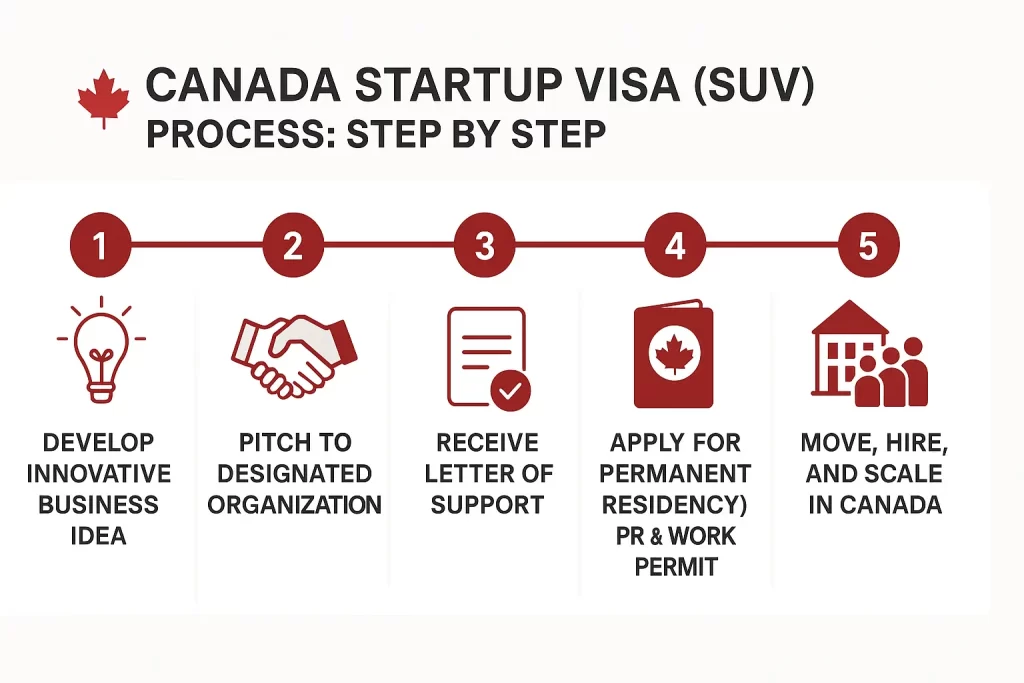
Second, founders pitch their idea to a designated organization. This is where the business plan and pitch deck take center stage. Organizations will assess the venture’s scalability, the founders’ experience, and the potential economic contribution to Canada. If the organization is convinced, it will issue a Letter of Support, the critical document required for the PR application.
The next stage is the submission of the permanent residency application to IRCC. This includes language test results (minimum CLB 5), proof of settlement funds, police certificates, medical exams, and the Letter of Support. While waiting for approval, founders may also apply for a temporary work permit, which allows them to begin operations in Canada immediately.
Once PR is approved, the founder and their family can relocate. This stage involves practical steps such as registering the company, hiring Canadian employees, and building customer traction. The strength of the initial business plan often determines how quickly the startup can transition from concept to execution in the Canadian market.
Common Mistakes and How to Avoid Them
Despite the advantages of the SUV Program, many applications are delayed or rejected due to avoidable mistakes. One of the most common is unclear ownership structures. If founders and the designated organization do not meet the voting rights thresholds, the application will not move forward. Another frequent issue is weak or incomplete business plans. Applications that fail to include detailed market research, financial forecasts, and job creation strategies rarely receive Letters of Support.
A third mistake is approaching the wrong designated organization. Not all organizations support every industry or business stage; founders should carefully match their venture with an incubator, accelerator, or investor group aligned to their sector. Finally, incomplete documentation, such as missing settlement fund proof or inconsistent application details, can result in significant delays. Thorough preparation and professional guidance are the best ways to avoid these pitfalls.
Is the Canada Startup Visa Right for You?
The SUV Program is best suited for entrepreneurs with innovation-driven, high-growth business ideas. It is not designed for small retail shops, family-owned restaurants, or traditional service businesses. Instead, it rewards startups that can expand globally while making tangible contributions to Canada’s economy. For founders with innovative solutions, especially in technology or knowledge-intensive sectors, the SUV is one of the fastest and most secure immigration routes available.
Entrepreneurs who prioritize stability for their families will also find the SUV attractive. With direct permanent residency, founders, spouses, and children can access Canadian healthcare, education, and social benefits. This stability allows entrepreneurs to focus fully on business growth rather than immigration uncertainty. By contrast, individuals with substantial capital but without an innovative concept may find traditional investor visas a better fit.
Key Benefits of the Canada Startup Visa
The appeal of the SUV Program lies in its combination of entrepreneurial opportunity and family security. Successful applicants gain direct PR for themselves and their dependents, access to Canada’s innovation ecosystem, and the chance to scale globally from a respected market base. They also avoid the heavy personal investment requirements of investor visas, making the program more inclusive for resourceful but less capitalized founders.
Beyond the immigration benefits, the SUV fosters genuine economic integration. Founders contribute to GDP through taxation, job creation, and innovation spillovers, while also gaining access to world-class research institutions, talent pools, and funding networks. Over time, many entrepreneurs transition from permanent residency to citizenship, embedding their ventures—and their families—deeply into Canadian society.
Get Help With Your Business Plan or Pitch Deck
Given the centrality of the business plan, professional guidance can dramatically improve the chances of securing both organizational support and PR approval. Experienced advisors help ensure the plan reflects Canadian market realities, aligns with IRCC expectations, and speaks the language of investors and incubators. This support includes refining the narrative, building robust financial projections, and clearly communicating innovation and scalability.
For entrepreneurs considering the Canada Startup Visa Program in 2025, investing in a polished, professional plan is not optional—it is a strategic necessity. It positions the startup for acceptance, equips the founders with a roadmap for execution, and ensures the business makes a strong start in the Canadian market.
Leave a Reply
Your email address will not be published. Required fields are marked *