
 Back
BackCan Your E2 Visa Become a Green Card?
The E-2 Treaty Investor Visa has become a popular doorway for international entrepreneurs seeking to build businesses in the United States. It’s flexible, renewable, and allows founders to live, work, and grow their enterprises without the annual quotas that plague other visa categories. For many, it feels like the perfect balance between opportunity and stability.
Yet there’s one major limitation: the E-2 is not permanent. It is classified strictly as a nonimmigrant visa. That means no matter how much capital you invest, how many jobs you create, or how deeply you integrate into the U.S. economy, the E-2 itself does not convert into a green card.
This creates an uncomfortable tension. Investors are expected to put down roots, but they are not guaranteed permanence. Families relocate, children attend U.S. schools, companies hire American staff — all under the shadow of a visa that could end with the next renewal cycle. It’s no wonder that one of the most common questions E-2 holders ask is: Can my E-2 lead to permanent residency?
The short answer: not directly. But with the right strategy, yes, it can be the first step toward a green card.
Why the E-2 Visa Doesn’t Lead Directly to a Green Card
To understand why, it helps to look at the visa’s statutory design. The E-2 was created under Section 101(a)(15)(E)(ii) of the Immigration and Nationality Act, which defines it purely as a temporary investor visa.
E-2 holders must prove nonimmigrant intent at entry. Every renewal depends on the business remaining viable and on the applicant maintaining the intent to eventually depart. Unlike H-1B or L-1 visa categories, which allow “dual intent” (temporary stay while pursuing permanent residency), the E-2 provides no such flexibility.
Other limitations add to the uncertainty:
- Country reciprocity: Visa length varies by treaty. U.K. nationals may receive five years, while others only get three months.
- Renewal pressure: Even strong businesses can face scrutiny if officers suspect permanent intent.
- Risk of conflict: Filing for a green card while on E-2 can raise questions of misrepresentation, since the original application required proof of temporary intent.
In practice, this means E-2 holders who want permanence must “step sideways” into other immigration categories designed to lead to green cards.
Pathways from the E-2 Visa to Permanent Residency
There is no one-size-fits-all solution. The right pathway depends on the investor’s business, capital resources, industry, and personal circumstances. Below are the main routes E-2 holders pursue.
EB-5 Investor Green Card
For many E-2 investors, the EB-5 program is the most natural upgrade. Both categories are investment-based, but EB-5 is explicitly designed to deliver permanent residency.
At its core, the EB-5 requires:
- $1,050,000 investment in a new commercial enterprise, or
- $800,000 investment in a targeted employment area (TEA) such as rural or high-unemployment regions
- Creation or preservation of at least 10 full-time jobs for U.S. workers
For E-2 entrepreneurs, this often means scaling up their existing business or launching an expansion that meets EB-5 requirements.
The advantages are clear: EB-5 leads directly to conditional permanent residency for the investor, spouse, and children, with the chance to remove conditions after two years. But the trade-offs are serious. The program requires airtight documentation of the lawful source of funds, detailed business plans consistent with the Matter of Ho precedent, and verifiable proof of job creation. Many E-2 businesses are not structured at the right scale and must undergo major capital injections or restructuring to qualify.
In short: EB-5 is a strong pathway for investors with resources to grow aggressively, but it demands commitment, planning, and precision.
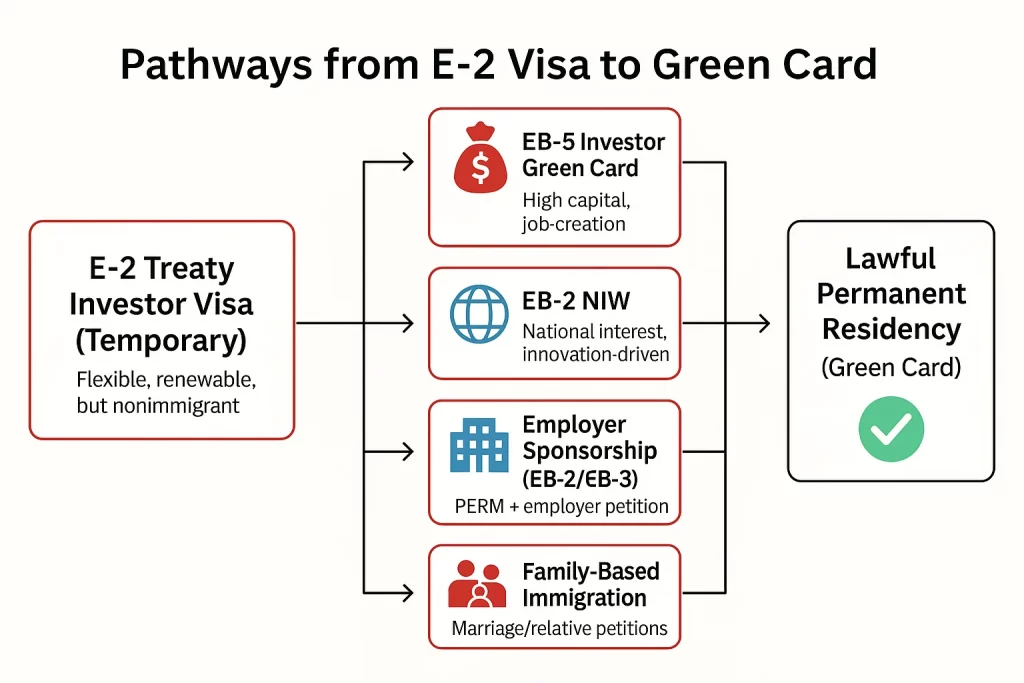
EB-2 National Interest Waiver (NIW)
The EB-2 NIW is another powerful option, especially for entrepreneurs whose ventures align with U.S. policy priorities. Unlike EB-5, it is not tied to a fixed investment or job creation quota. Instead, it is judged on whether the applicant’s work serves the national interest.
Under the Matter of Dhanasar framework, applicants must show:
- Their endeavor has substantial merit and national importance
- They are well-positioned to advance the endeavor
- It benefits the U.S. to waive the labor certification requirement
This makes NIW particularly attractive for E-2 investors in technology, healthcare, renewable energy, and advanced manufacturing. Evidence may include expert letters, market analysis, proof of innovation, and detailed business plans showing national impact.
The upside is flexibility — no strict dollar amounts, no rigid job quotas. But the downside is subjectivity. USCIS applies a high evidentiary standard, and applicants must present a compelling, well-documented case.
In short: NIW is an excellent option for E-2 entrepreneurs in high-impact industries, but it hinges on building a persuasive narrative backed by strong evidence.
Employer-Sponsored Green Card (EB-2/EB-3)
Not all E-2 investors remain entrepreneurs. Some transition into roles with U.S. companies that sponsor them for permanent residency through EB-2 or EB-3 classifications.
This pathway requires:
- A U.S. employer willing to sponsor
- Completion of the PERM labor certification, proving no qualified U.S. worker is available for the role
The benefit is structure — the EB-2/EB-3 process is well-established. The drawback is dependency. It requires employer cooperation, can involve long processing times, and often means giving up entrepreneurial control.
In short: Employer sponsorship offers a reliable path for those ready to step out of ownership and into employment, but it’s less appealing for career entrepreneurs.
Family-Based Immigration
While most E-2 investors focus on business-driven pathways like EB-5 or NIW, family-based immigration remains one of the most common and reliable routes to permanent residency. For investors who marry U.S. citizens or who already have close relatives with citizenship or green cards, this option often provides a faster and less complex alternative to the employment- or investment-based categories.
The process is most straightforward for those married to U.S. citizens. In that case, the spouse can file an immediate relative petition, which is not subject to visa quotas or long waiting periods. Adjustment of status can typically be filed while the E-2 investor is still in valid status, and because immediate relatives are prioritized, the timeline is usually shorter than most other categories. For those with family members who are lawful permanent residents or U.S. citizens, petitions are still possible but fall into preference categories that may involve significant backlogs depending on the applicant’s country of origin.
The attraction of this pathway lies in its simplicity. Unlike EB-5 or NIW, there are no investment thresholds, no job creation quotas, and no business plans to defend. It shifts the basis for immigration from entrepreneurship to family unity. The trade-off, of course, is that it depends entirely on personal circumstances rather than business performance.
Key options include:
- Marriage to a U.S. citizen → immediate eligibility as an “immediate relative,” bypassing quotas.
- Petitions from lawful permanent resident or citizen family members → available but subject to visa bulletin priority dates and longer wait times.
In short: Family-based immigration is often the smoothest and most predictable route for eligible E-2 holders, though it is tied entirely to personal life rather than business strategy.
Diversity Visa Lottery
Finally, there’s the DV lottery. Each year, the U.S. government issues 50,000 green cards to nationals of eligible countries through a random draw.
The pros are obvious: no capital requirement, no sponsorship, no family ties needed. But the cons are just as clear: the odds are extremely low, and it cannot form the basis of a serious long-term plan.
In short: The DV lottery is more luck than strategy — a bonus if it happens, but never a plan to rely on.
Common Challenges in Transitioning
Even with multiple pathways available, E-2 investors face recurring obstacles. The most common include:
- Nonimmigrant intent conflict: Filing for a green card can clash with the original E-2 requirement to depart, creating risks of misrepresentation.
- Timing issues: If an E-2 expires while an immigrant petition is pending, the investor risks falling out of status.
- Travel restrictions: Departing and re-entering the U.S. during this process can trigger denials if officers suspect immigrant intent.
- Business restructuring: Adapting an E-2 business to EB-5 or NIW standards often requires capital infusion, more formal governance, and detailed compliance.
These challenges don’t make the transition impossible, but they highlight why careful sequencing and professional guidance are essential.
Strategic Planning for E-2 Investors
The best strategy is to view the E-2 not as a permanent solution, but as a launchpad for future residency. Smart investors start preparing from day one.
Practical steps include:
- Document everything: Keep clean financial records, tax filings, and payroll documentation.
- Think ahead: If EB-5 is the goal, design hiring and capital structures to meet requirements early.
- Build national relevance: If NIW is the aim, start gathering evidence of how your venture benefits U.S. priorities.
- Engage professionals: Work with immigration attorneys and business consultants who can align legal and financial strategies.
Bottom line: The strongest E-2-to-green-card cases are built years before the petition is filed.
Conclusion: The E-2 as a Stepping Stone
The E-2 visa is a powerful tool for international entrepreneurs, but it is not a destination. It was designed as a temporary visa, and that’s exactly how USCIS treats it. For investors and their families who want permanence, the path forward requires planning, resources, and often significant restructuring.
From the capital-heavy EB-5 program to the policy-driven NIW, employer sponsorship, and family-based petitions, E-2 investors do have options. Each pathway comes with its own requirements, risks, and opportunities.
The key is to start early, structure strategically, and document thoroughly. Treated correctly, the E-2 is not just a temporary visa — it is a stepping stone to permanent residency and a lasting future in the United States.
Leave a Reply
Your email address will not be published. Required fields are marked *