
 Back
BackEarly-stage companies rarely fail due to insufficient effort. Failure more often results from the inability to convert sustained activity into durable, compounding progress.
Teams remain active across functions. Product work advances. Sales conversations occur. Partnerships are explored. Despite this level of motion, the underlying condition of the business frequently remains unchanged after a quarter. Demand is still unverified, delivery capability remains inconsistent, and economic viability is unresolved.
This pattern is typically the result of weak execution structure rather than lack of capability. In the absence of a disciplined mechanism that connects strategy to outcomes, work fragments across priorities, and time is consumed without materially improving the company’s position.
A first 90-day execution plan addresses this structural deficiency.
The plan functions as an operating system that translates strategic intent into defined outcomes, assigns responsibility, establishes measurement, and enforces a regular decision cadence. Its purpose is to impose execution discipline and operational alignment.
When designed correctly, the plan serves as a short-cycle operating contract that governs three questions:
-
Which outcomes must exist in 90 days for the business to be in a stronger position
-
What work must occur, and in what sequence, to produce those outcomes
-
How progress will be evaluated and adjusted as constraints and information change
The framework outlined below reflects how experienced operators and advisory teams structure early execution cycles that hold under operational, financial, and investor scrutiny.
Definition and Scope of a 90-Day Execution Plan
A 90-day execution plan is a time-bounded operating roadmap that establishes clarity across outcomes, ownership, sequencing, and governance.
The plan specifies:
-
a limited set of outcomes that materially affect the business
-
the workstreams required to achieve those outcomes
-
ownership and decision authority
-
resource and financial constraints
-
a fixed cadence for review and adjustment
The primary function of the plan is to make progress inspectable. Trade-offs are explicit. Activity that does not advance defined outcomes becomes visible. Execution risk is surfaced early rather than deferred.
The plan assumes that conditions will evolve during the execution window. Customer behavior, technical complexity, and capital availability often change in early-stage environments. The role of the plan is to preserve priority discipline while allowing tactical adaptation within defined boundaries.
Planning Horizon Rationale
Ninety days represents the shortest interval over which meaningful operational and commercial signals can be observed without excessive noise.
Shorter horizons tend to emphasize activity without producing validated learning. Longer horizons require assumptions that early-stage companies cannot reliably defend. The 90-day window balances urgency with evidence generation.
This horizon aligns with:
-
investor and board reporting cycles
-
product release and stabilization timelines
-
pipeline development and sales cycle observation
-
burn rate management and runway planning
Effective 90-day plans operate as contained strategic cycles. Scope is constrained, metrics are explicit, and feedback loops are frequent. The objective is decision-relevant learning rather than long-range projection.
Core Elements of a Credible 90-Day Plan
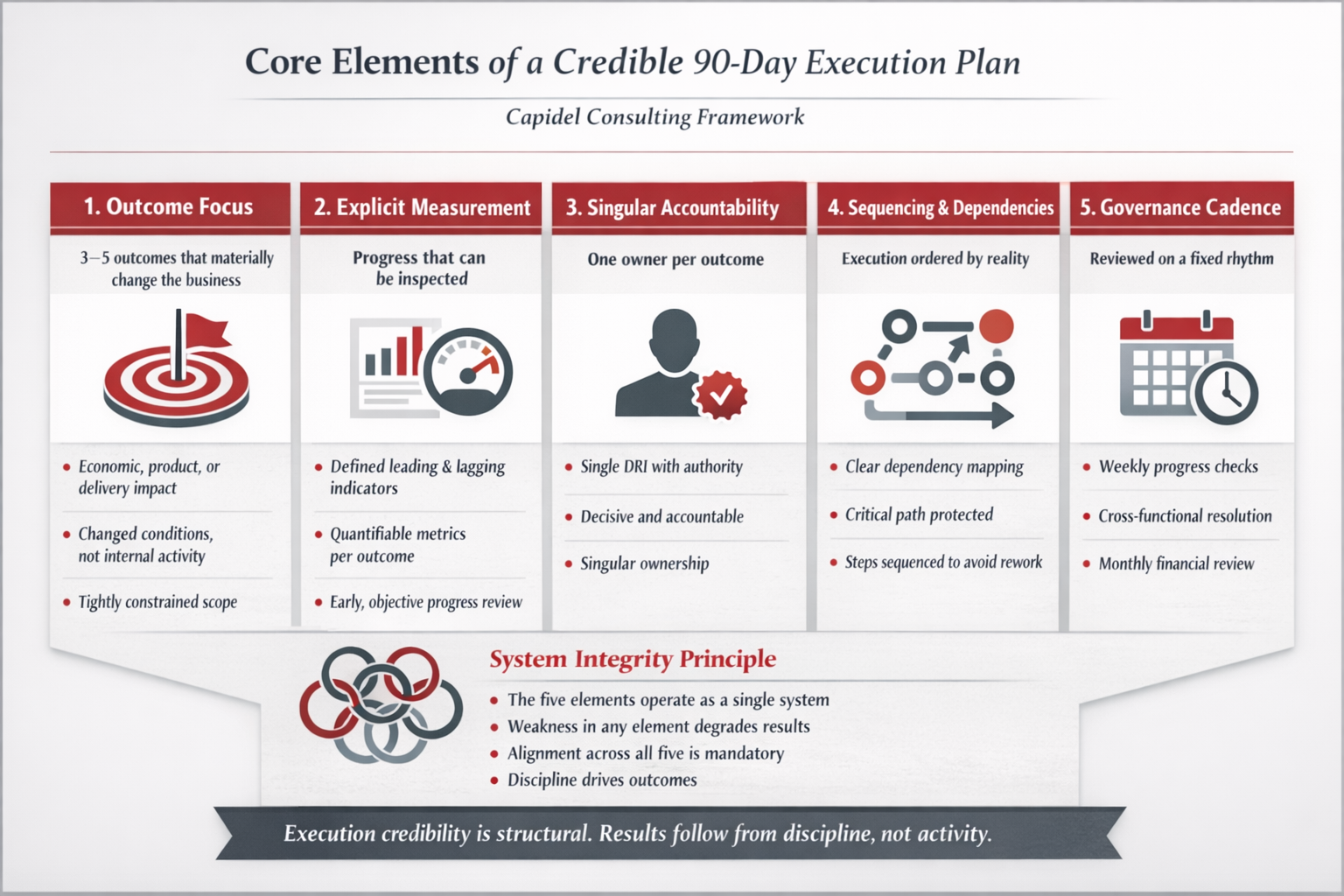
Execution credibility depends on the presence of five elements.
First, the plan defines a small number of outcomes, typically three to five, that materially affect the company’s commercial, product, or financial position. Outcomes represent changed conditions rather than internal milestones.
Second, each outcome is paired with explicit measurement. Both leading indicators and lagging indicators are defined. Measurement reduces interpretive reporting and enables timely intervention.
Third, accountability is singular. Each outcome has one directly responsible owner with authority to make trade-offs and escalate constraints.
Fourth, sequencing logic is explicit. Dependencies are acknowledged and reflected in execution order. The critical path is identified and protected.
Fifth, governance cadence is established. Progress is reviewed weekly, dependencies are addressed cross-functionally, and financial reality is reassessed monthly.
These elements function as a system. Weakness in any one reduces execution quality across the plan.
Establishing Baseline Operating Reality
Targets established without reference to current constraints result in unreliable plans. Baseline assessment defines the boundary conditions within which execution must occur.
Commercial baseline
The commercial baseline captures the current state of demand evidence. This includes definition of the ideal customer profile, pipeline composition, early conversion behavior, and assumptions regarding deal velocity and cycle length. Data may be incomplete, but unexamined assumptions introduce execution risk.
Product baseline
The product baseline documents system stability, unresolved technical constraints, and delivery capacity. Roadmap commitments are reconciled with actual engineering throughput. Known debt and trade-offs are surfaced explicitly.
Operating baseline
The operating baseline defines team capacity, role coverage, and decision latency. External dependencies such as vendors, integrations, and regulatory requirements are identified along with associated timing risks.
Financial baseline
The financial baseline establishes current burn rate, cash position, and effective runway. Burn rate defines the rate of capital consumption. Runway defines the time available for execution before financing pressure increases.
Execution planning occurs within these constraints. Inability to articulate them clearly undermines delivery credibility.
Selection of Must-Win Outcomes
Early execution cycles degrade when priorities are diffuse. Limiting outcomes enforces focus and resource concentration.
Outcomes should directly support one or more early-stage validation requirements:
-
evidence of customer demand
-
reliability of delivery capability
-
visibility into unit economics
-
repeatability of a growth or delivery motion
-
readiness for external capital evaluation
Each outcome should materially improve the company’s position within the 90-day window. Outcomes that do not affect risk, credibility, or trajectory are deferred.
Translating Outcomes into Measurable Objectives
Objectives define directional intent. Measurement converts intent into operational accountability.
OKRs are frequently used due to their separation of objective and evidence. Objectives describe the condition to be achieved. Key results define the observable signals that confirm achievement.
Limiting the number of objectives and key results reduces complexity. Measurement thresholds, rates, and dates are preferred over task completion indicators. Progress is assessed through changed conditions rather than activity volume.
Structuring Workstreams and Dependencies
Execution is organized through defined workstreams aligned to functional domains such as product, go-to-market, customer delivery, operations, and finance.
Dependencies are identified and reflected in sequencing. Certain activities must precede others to produce valid results. Pricing decisions precede channel expansion. Instrumentation precedes optimization. Onboarding stability precedes acquisition scaling.
Failure to account for dependency logic increases rework and delays learning.
Accountability and Decision Authority
Clear ownership accelerates execution. Each outcome is assigned to a single directly responsible individual. Contributors support delivery, while ownership remains singular.
Decision authority is explicit. Owners are empowered to make trade-offs within defined constraints and escalate issues that affect sequencing or resource allocation.
Shared responsibility without defined authority increases latency and reduces execution quality.
Closing Perspective
A 90-day execution plan strengthens materially when grounded in defensible research and reconciled to a financial model. Linking strategy to measurable outcomes and capital constraints improves execution reliability and decision quality.
This research-to-strategy-to-numbers linkage reflects how Capidel Consulting approaches early-stage execution: aligning business plans, market research, and financial models to produce outcomes that withstand operational and investor evaluation.
Execution quality is determined by structure, not effort.
Leave a Reply
Your email address will not be published. Required fields are marked *